SUBSCRIBE TO OUR FREE NEWSLETTER
Daily news & progressive opinion—funded by the people, not the corporations—delivered straight to your inbox.
5
#000000
#FFFFFF
To donate by check, phone, or other method, see our More Ways to Give page.
Daily news & progressive opinion—funded by the people, not the corporations—delivered straight to your inbox.
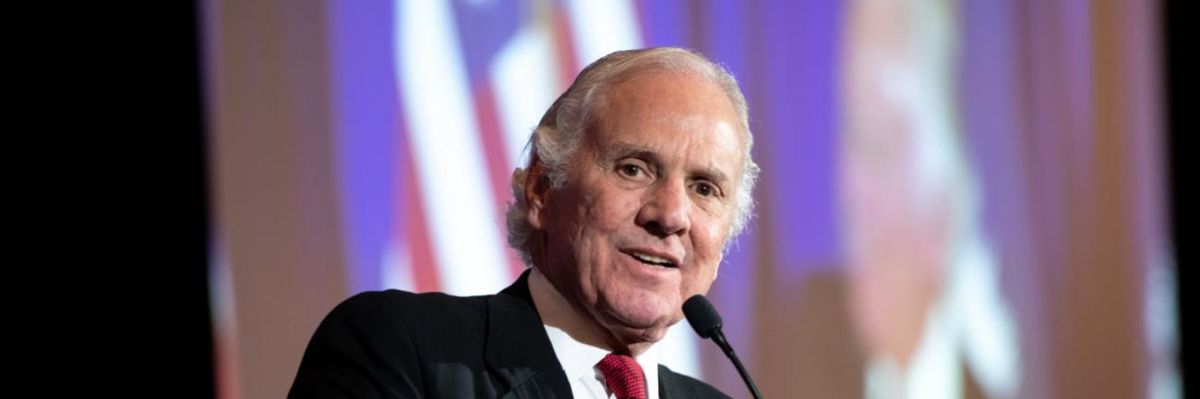
South Carolina Gov. Henry McMaster speaks to a crowd during an election night party on November 3, 2020 in Columbia, South Carolina. (Photo: Sean Rayford/Getty Images)
Civil rights organizations and Democratic lawmakers reiterated their calls for an end to the death penalty nationwide on Monday after South Carolina's Republican Gov. Henry McMaster signed into law a bill requiring death row inmates to choose between the electric chair and a firing squad as their method of execution.
The new law aims to restart executions in South Carolina after a 10-year pause due to a shortage of lethal injection drugs. Under previous state law, people facing execution were given a choice between a lethal drug cocktail--the default method--and electrocution.
"This is brutal, inhumane, and does nothing to deter crime. The death penalty needs to be abolished."
--Charles Booker
S. 200, which won final approval in the GOP-controlled South Carolina legislature last week, adds the firing squad as a method of execution and makes the electric chair the default. At present, there are 37 people on death row in South Carolina.
"The cruelty is the point. Abolish the death penalty," Rep. Ayanna Pressley (D-Mass.), a leading congressional proponent of death penalty abolition at the federal level, tweeted in response to McMaster's signing of the bill.
Charles Booker, a former Kentucky state lawmaker who is exploring a second run for U.S. Senate in 2022, echoed that message.
"This is brutal, inhumane, and does nothing to deter crime," Booker said. "The death penalty needs to be abolished."
As the Associated Press reported Monday, it's unclear how long it will take South Carolina to resume executions under the new law. The outlet notes that South Carolina officials are conducting "preliminary research" into how firing squad executions are carried out in Mississippi, Oklahoma, and Utah--the only other states that currently allow the method.
"It blows my mind to see my state heading backwards," South Carolina State Rep. Justin Bamberg, a Democrat, said Sunday. "There's no humane way to kill a human being. I don't view the firing squad any better than the electric chair."
In a statement after S. 200 cleared its final hurdle in the South Carolina Senate last week, Frank Knaack, executive director of the state's ACLU chapter, said that "South Carolina's capital punishment evolved from lynchings and racial terror, and it has failed to separate its modern capital punishment system from this racist history."
"Despite clear and incontrovertible evidence that South Carolina's capital punishment system is racist, arbitrary, and error-prone, today our legislators passed a bill to keep the state's machinery of death moving," said Knaack. "The death penalty is modern-day lynching. It must be abolished."
On the campaign trail, President Joe Biden promised to "work to pass legislation to eliminate the death penalty at the federal level" as former President Donald Trump carried out an execution spree during his final days in office.
But Biden has been silent on the issue since taking office, frustrating criminal justice reform activists who were hoping for swift action on the death penalty from the first president to publicly oppose the death penalty and express support for its elimination.
"There are mounting calls from criminal justice, law enforcement, and other leaders for the president to seize this moment as an increasing number of governors in states like Virginia have moved in the direction to abolish the death penalty," Miriam Krinsky, executive director of the legal advocacy group Fair and Just Prosecution, told CNN last month. "The death penalty should end in the federal landscape once and for all and in a way that can't be resurrected by a future administration."
Dear Common Dreams reader, It’s been nearly 30 years since I co-founded Common Dreams with my late wife, Lina Newhouser. We had the radical notion that journalism should serve the public good, not corporate profits. It was clear to us from the outset what it would take to build such a project. No paid advertisements. No corporate sponsors. No millionaire publisher telling us what to think or do. Many people said we wouldn't last a year, but we proved those doubters wrong. Together with a tremendous team of journalists and dedicated staff, we built an independent media outlet free from the constraints of profits and corporate control. Our mission has always been simple: To inform. To inspire. To ignite change for the common good. Building Common Dreams was not easy. Our survival was never guaranteed. When you take on the most powerful forces—Wall Street greed, fossil fuel industry destruction, Big Tech lobbyists, and uber-rich oligarchs who have spent billions upon billions rigging the economy and democracy in their favor—the only bulwark you have is supporters who believe in your work. But here’s the urgent message from me today. It's never been this bad out there. And it's never been this hard to keep us going. At the very moment Common Dreams is most needed, the threats we face are intensifying. We need your support now more than ever. We don't accept corporate advertising and never will. We don't have a paywall because we don't think people should be blocked from critical news based on their ability to pay. Everything we do is funded by the donations of readers like you. When everyone does the little they can afford, we are strong. But if that support retreats or dries up, so do we. Will you donate now to make sure Common Dreams not only survives but thrives? —Craig Brown, Co-founder |
Civil rights organizations and Democratic lawmakers reiterated their calls for an end to the death penalty nationwide on Monday after South Carolina's Republican Gov. Henry McMaster signed into law a bill requiring death row inmates to choose between the electric chair and a firing squad as their method of execution.
The new law aims to restart executions in South Carolina after a 10-year pause due to a shortage of lethal injection drugs. Under previous state law, people facing execution were given a choice between a lethal drug cocktail--the default method--and electrocution.
"This is brutal, inhumane, and does nothing to deter crime. The death penalty needs to be abolished."
--Charles Booker
S. 200, which won final approval in the GOP-controlled South Carolina legislature last week, adds the firing squad as a method of execution and makes the electric chair the default. At present, there are 37 people on death row in South Carolina.
"The cruelty is the point. Abolish the death penalty," Rep. Ayanna Pressley (D-Mass.), a leading congressional proponent of death penalty abolition at the federal level, tweeted in response to McMaster's signing of the bill.
Charles Booker, a former Kentucky state lawmaker who is exploring a second run for U.S. Senate in 2022, echoed that message.
"This is brutal, inhumane, and does nothing to deter crime," Booker said. "The death penalty needs to be abolished."
As the Associated Press reported Monday, it's unclear how long it will take South Carolina to resume executions under the new law. The outlet notes that South Carolina officials are conducting "preliminary research" into how firing squad executions are carried out in Mississippi, Oklahoma, and Utah--the only other states that currently allow the method.
"It blows my mind to see my state heading backwards," South Carolina State Rep. Justin Bamberg, a Democrat, said Sunday. "There's no humane way to kill a human being. I don't view the firing squad any better than the electric chair."
In a statement after S. 200 cleared its final hurdle in the South Carolina Senate last week, Frank Knaack, executive director of the state's ACLU chapter, said that "South Carolina's capital punishment evolved from lynchings and racial terror, and it has failed to separate its modern capital punishment system from this racist history."
"Despite clear and incontrovertible evidence that South Carolina's capital punishment system is racist, arbitrary, and error-prone, today our legislators passed a bill to keep the state's machinery of death moving," said Knaack. "The death penalty is modern-day lynching. It must be abolished."
On the campaign trail, President Joe Biden promised to "work to pass legislation to eliminate the death penalty at the federal level" as former President Donald Trump carried out an execution spree during his final days in office.
But Biden has been silent on the issue since taking office, frustrating criminal justice reform activists who were hoping for swift action on the death penalty from the first president to publicly oppose the death penalty and express support for its elimination.
"There are mounting calls from criminal justice, law enforcement, and other leaders for the president to seize this moment as an increasing number of governors in states like Virginia have moved in the direction to abolish the death penalty," Miriam Krinsky, executive director of the legal advocacy group Fair and Just Prosecution, told CNN last month. "The death penalty should end in the federal landscape once and for all and in a way that can't be resurrected by a future administration."
Civil rights organizations and Democratic lawmakers reiterated their calls for an end to the death penalty nationwide on Monday after South Carolina's Republican Gov. Henry McMaster signed into law a bill requiring death row inmates to choose between the electric chair and a firing squad as their method of execution.
The new law aims to restart executions in South Carolina after a 10-year pause due to a shortage of lethal injection drugs. Under previous state law, people facing execution were given a choice between a lethal drug cocktail--the default method--and electrocution.
"This is brutal, inhumane, and does nothing to deter crime. The death penalty needs to be abolished."
--Charles Booker
S. 200, which won final approval in the GOP-controlled South Carolina legislature last week, adds the firing squad as a method of execution and makes the electric chair the default. At present, there are 37 people on death row in South Carolina.
"The cruelty is the point. Abolish the death penalty," Rep. Ayanna Pressley (D-Mass.), a leading congressional proponent of death penalty abolition at the federal level, tweeted in response to McMaster's signing of the bill.
Charles Booker, a former Kentucky state lawmaker who is exploring a second run for U.S. Senate in 2022, echoed that message.
"This is brutal, inhumane, and does nothing to deter crime," Booker said. "The death penalty needs to be abolished."
As the Associated Press reported Monday, it's unclear how long it will take South Carolina to resume executions under the new law. The outlet notes that South Carolina officials are conducting "preliminary research" into how firing squad executions are carried out in Mississippi, Oklahoma, and Utah--the only other states that currently allow the method.
"It blows my mind to see my state heading backwards," South Carolina State Rep. Justin Bamberg, a Democrat, said Sunday. "There's no humane way to kill a human being. I don't view the firing squad any better than the electric chair."
In a statement after S. 200 cleared its final hurdle in the South Carolina Senate last week, Frank Knaack, executive director of the state's ACLU chapter, said that "South Carolina's capital punishment evolved from lynchings and racial terror, and it has failed to separate its modern capital punishment system from this racist history."
"Despite clear and incontrovertible evidence that South Carolina's capital punishment system is racist, arbitrary, and error-prone, today our legislators passed a bill to keep the state's machinery of death moving," said Knaack. "The death penalty is modern-day lynching. It must be abolished."
On the campaign trail, President Joe Biden promised to "work to pass legislation to eliminate the death penalty at the federal level" as former President Donald Trump carried out an execution spree during his final days in office.
But Biden has been silent on the issue since taking office, frustrating criminal justice reform activists who were hoping for swift action on the death penalty from the first president to publicly oppose the death penalty and express support for its elimination.
"There are mounting calls from criminal justice, law enforcement, and other leaders for the president to seize this moment as an increasing number of governors in states like Virginia have moved in the direction to abolish the death penalty," Miriam Krinsky, executive director of the legal advocacy group Fair and Just Prosecution, told CNN last month. "The death penalty should end in the federal landscape once and for all and in a way that can't be resurrected by a future administration."